An AI search benchmark measures how often and how credibly your brand gets cited inside AI-generated answers. Run it by tracking mention rate — your presence across a fixed set of prompts — on at least three engines at once.
The baseline you need right now is simple: pick 25 to 50 prompts your buyers actually ask, and check whether your brand shows up.
- ChatGPT — the largest consumer AI search surface
- Perplexity — citation-heavy, favors sourced content
- Google AI Overviews — tied directly to existing search visibility
Mention rate alone won't tell you why you're losing ground, but it tells you whether you have a problem worth solving. Everything past that first check is refinement.
Key takeaways
An effective AI search benchmark pairs mention rate, citation rate, and share of voice with business signals, using at least 50 prompts per engine for decision-grade results.
| Point | Details |
|---|---|
| Start with mention rate | Measure brand presence across a fixed prompt set on ChatGPT, Perplexity, and Google AI Overviews. |
| Use IAB sample sizes | Run 50 to 100 or more prompt iterations per engine before treating results as decision-grade. |
| Weight authority, not just count | Score definitive mentions higher than supporting mentions to catch real quality shifts. |
| Pair visibility with revenue signals | Connect mention and citation trends to branded search lift, GA4 referrals, and conversion rate. |
| Automate with Prescy | Prescy tracks named-in-X-of-Y and citations on ChatGPT and Perplexity weekly, then ranks where to act. |
Table of contents
- What metrics matter most in AI search benchmarking?
- How do you design a reproducible AI search benchmark?
- How do you score and weight AI visibility results?
- How do you turn benchmark results into decisions?
- What should you fix first to improve AI visibility?
- What marketing teams get wrong about AI visibility
- How Prescy runs this benchmark for you
- Sources
What metrics matter most in AI search benchmarking?
Mention rate is your starting metric because presence, not clicks, is the currency of AI answers. Calculate it as the percentage of prompts in your set where your brand appears anywhere in the response, cited or not. A brand mentioned in multiple prompts has a mention rate reflecting its presence across those prompts. No click is required for that mention to shape a buyer's impression.
AI share of voice takes mention rate one step further: your mentions divided by total brand mentions across all competitors in the same response set. There's no universal target here. Similarweb's AI Brand Visibility Index found leader shares ranging from roughly 15.9% in finance to 54.4% in consumer electronics, with meaningful visibility starting around 5 to 8% in most categories. Compare your share against your actual competitive cluster, not an arbitrary industry average.
Citation rate narrows further: it's the share of mentions that come with an actual link or explicit attribution back to your site. A mention with no citation still shapes perception, but a mention with a citation drives referral traffic and reinforces authority.
Sentiment and accuracy checks matter as much as raw counts. A brand cited frequently but described incorrectly — wrong pricing, outdated features, misattributed claims — can do more damage than a low mention rate. Semrush's AI visibility guidance recommends tracking sentiment and prompt-level accuracy alongside share metrics, then pairing all of it with branded search lift, GA4 referral trends, and conversion rate to prove the numbers matter to revenue.
How do you design a reproducible AI search benchmark?
A benchmark that changes its methodology every quarter isn't a benchmark. It's a snapshot. Here's how to build one that holds up over time.
- Fix your engine tier list. Treat ChatGPT, Perplexity, and Google AI Overviews as Tier 1, since they cover the largest share of AI-assisted buyer research. Add Gemini and Claude as Tier 2 if your audience or sales team reports usage there.
- Split your query set into three buckets. Out of 50 total prompts, a workable split is 15 branded ("What is [brand] known for?"), 20 category ("best tools for X"), and 15 use-case ("how do I solve Y problem"). Use-case prompts tend to reveal gaps branded prompts hide.
- Follow IAB sample-size guidance. IAB's measurement framework treats fewer than 50 queries per engine as exploratory only. Decision-grade conclusions — the kind you'd put in front of a VP — need 50 to 100 or more prompt iterations per engine.
- Run on a fixed cadence. Weekly runs with weekly snapshots and a monthly rollup summary catch drift early without drowning you in noise.
- Document everything. Log the exact prompt phrasing, the model version, and whether sessions were cleared between runs. A single unnoticed model update can invalidate a month of trend data.
Pro tip: Keep a version log of your prompt set in a shared spreadsheet. If you tweak even one word in a prompt, treat it as a new data series rather than a continuation of the old one.
How do you score and weight AI visibility results?
The core formulas are straightforward, but the weighting choices are where most benchmarks go wrong. Mention rate is mentions divided by total prompts. Citation rate is citations divided by mentions. Share of voice is your mentions divided by total category mentions across the same prompt set.
Weighting adds nuance a raw count misses:
- Authority weighting: score a definitive mention (your brand named as the recommended option) at 3 points, and a supporting mention (named alongside three others) at 1 point. This surfaces quality shifts a flat mention count hides.
- First-mention boost: brands named first in a list-style AI answer tend to get disproportionate attention, so a small bonus weight for position is defensible if you apply it consistently.
- Prompt-intent weighting: use-case prompts often sit closer to purchase intent than category prompts, so weighting them higher in a composite score better reflects commercial impact.
If you build a composite score, pair it with raw metrics like mention rate, citation rate, and share of voice to maintain clarity. A composite can mask a failure mode — strong overall visibility with a collapsing citation rate — that a stakeholder needs to see directly.
With a dataset under 50 prompts per engine, treat any week-over-week movement as noise, not a trend.
How do you turn benchmark results into decisions?
A benchmark report that doesn't drive a decision is a spreadsheet nobody reads twice. Structure every report around four questions:
- Where do we appear? Mention rate and share of voice by engine and by prompt bucket.
- How accurately are we described? Sentiment and factual accuracy flags, especially on branded prompts.
- Is our position improving relative to competitors? Trend line on share of voice, not just your own mention count in isolation.
- Which business metrics moved? Branded search volume, GA4 referral sessions from AI engines, and conversion rate on the pages AI answers point to.
A quick diagnostic pattern worth memorizing: rising mentions paired with a flat or falling citation rate usually points to a content attribution problem — engines know you exist but aren't finding a clear, linkable source to cite. That's a content fix, not a PR fix.
Build reports with an executive summary, current status, trends, business impacts, and detailed appendices for deeper insight.
| Point | Details |
|---|---|
| Start with mention rate | Presence across a fixed prompt set is the fastest signal of an AI visibility gap. |
| Weight by authority | Score definitive mentions higher than supporting ones to catch quality shifts. |
| Watch citation rate separately | Rising mentions with flat citations signals a content attribution problem. |
What should you fix first to improve AI visibility?
Once you know where the gaps are, prioritize fixes using impact × gap × effort, so limited time goes toward the plays that move the needle fastest.
- Close content gaps on high-priority prompts. Build data-rich pages that directly answer the use-case prompts where you're absent. Generic product pages rarely get cited; specific, sourced answers do.
- Fix the technical basics AI crawlers rely on. Stable canonical URLs, permalinks that don't change, and structured schema markup for facts and pricing make your content easier for retrieval systems to parse and cite correctly.
- Build citable authority. Publish original research, name real subject-matter authors, and create linkable resources. Definitive attributions cluster around content engines can point to with confidence.
- Run focused experiments and measure per-engine lift. Fix one prompt cluster, remeasure mention rate on just that cluster within two to four weeks, then trace whether branded search or conversions moved.
Pro tip: Prioritize actions based on potential impact, gap size, and effort required rather than intuition. A high-impact, high-gap, low-effort fix — adding schema to an existing page — beats a flashy content overhaul every time.
What marketing teams get wrong about AI visibility
Most teams treat AI visibility like a vanity metric borrowed from social media: track the number, report it up, move on. That's the wrong instinct. The number only means something next to citation rate and sentiment, because a brand can be mentioned constantly and still lose the sale if the mention is wrong or buried behind three competitors.
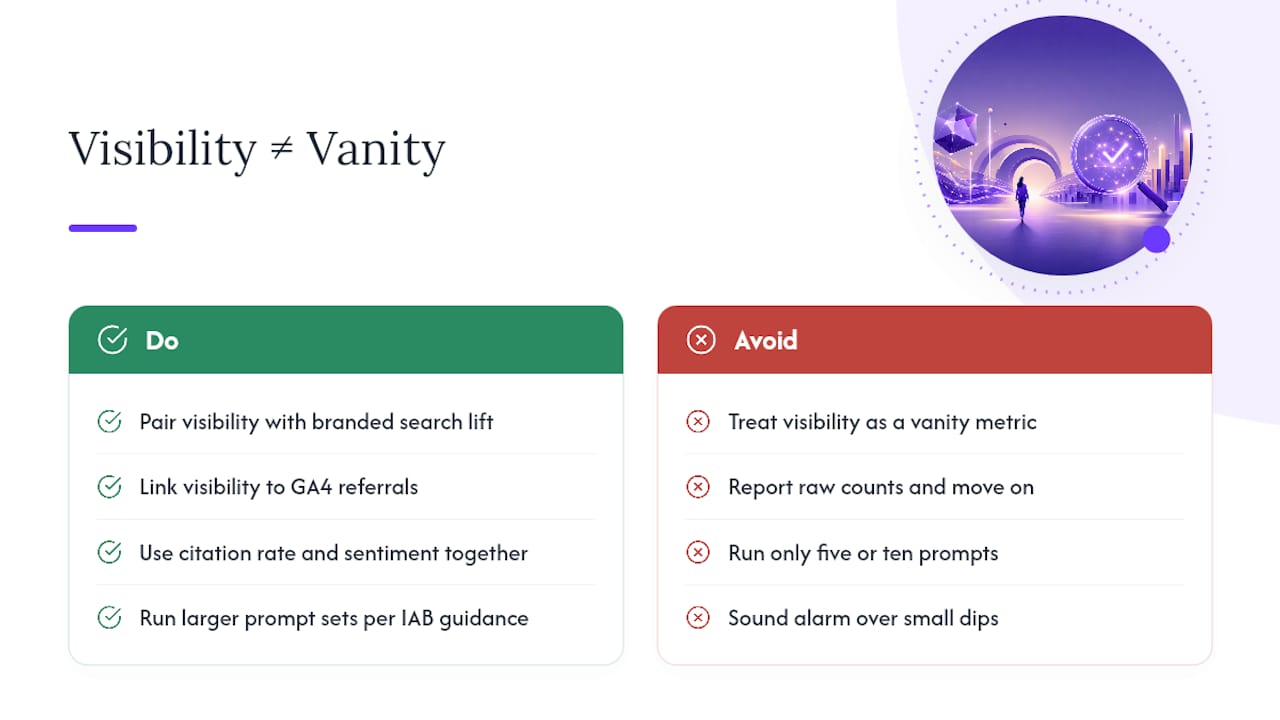
The bigger miss is sample size. Plenty of teams run five or ten prompts by hand, see a dip, and sound an alarm that isn't statistically real. IAB guidance recommends larger prompt sets before results can be considered decision-grade. Below that, you're looking at noise dressed up as a trend.
What actually deserves priority is the pairing most teams skip: connecting visibility metrics to branded search lift and GA4 referrals. Linking visibility metrics to business impact turns data into actionable intelligence for executives. That's the difference between a benchmark that gets read once and one that shapes next quarter's content roadmap.
How Prescy runs this benchmark for you
Prescy is built to run a decision-grade weekly benchmark without the manual prompt-by-prompt tracking. Today it measures ChatGPT and Perplexity — 60 core buyer questions, up to five samples on ChatGPT and five on Perplexity each week — then reports named-in-X-of-Y counts, cited domains, and a ranked source queue against named competitors. Google AI Overviews is in testing, not in that loop yet; treat Search Console’s Generative AI report as the Overview track for now.
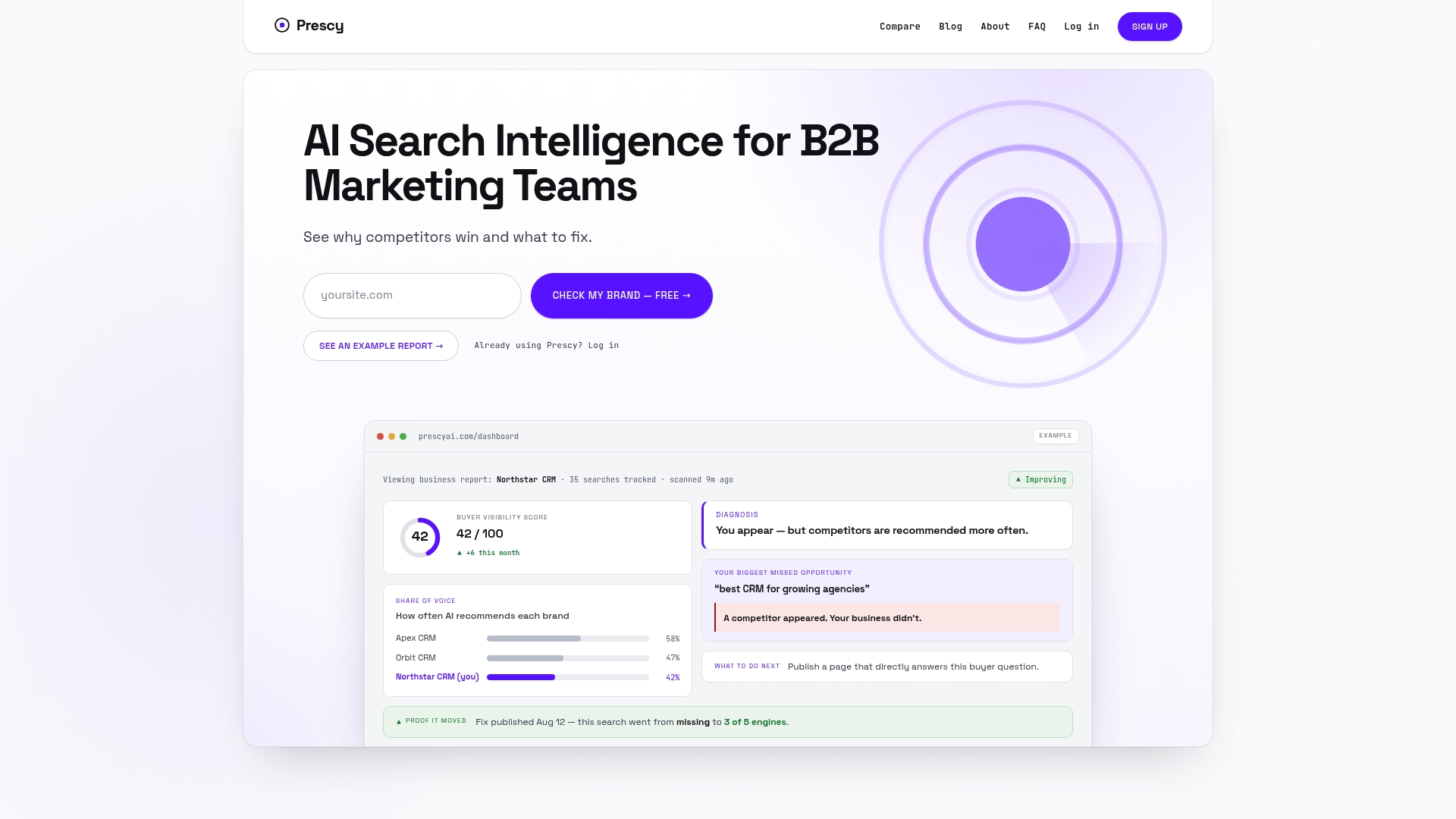
Where most teams stall is the diagnosis step: knowing you're losing visibility is easy; knowing why and what to fix is harder. Prescy's AI visibility scoring methodology breaks down exactly how mentions, citations, and sentiment feed into a single score, then pairs that score with specific, evidence-backed content recommendations tied to the gaps it finds. You can see how the platform tracks visibility across engines before committing to anything.
The fastest way to see where you stand is to run a free AI visibility check. Within minutes, you'll see your current recognition against competitors and a first look at where the gaps sit.
Sources
- What is a Good AI Brand Visibility Score — Similarweb
- AI Brand Visibility Measurement Framework — Cloro