
A ChatGPT citation is any instance where the model names your brand or attributes a claim to your URL inside a generated answer. If your brand isn't showing up where it should, the fastest triage is a two-step check: confirm AI crawlers are actually reaching your pages by checking server logs, then run a controlled sample of prompts to see whether mentions and citations follow. Fix crawler access first. Only then does content and sampling work start to pay off.
TL;DR:
- Ensuring eligibility requires correcting server access issues, such as robots.txt or CDN blocking, before content or sampling efforts can be effective.
- Proper auditing involves verifying crawlers’ actual access using IP range checks and tracking AI referral traffic with consistent UTM parameters.
- Repeated prompt sampling, at least three runs per prompt, is essential to distinguish reliable mentions and citations from chance occurrences.
- AI citation metrics are inherently unstable, as responses vary with each run and engine, making confidence intervals and sample sizes critical for accuracy.
- Automated tools can streamline monitoring by continuously verifying eligibility, sampling prompts, and tracking AI visibility across multiple engines.
Eligibility vs Citation vs Mention: The Three Layers You're Actually Measuring
Most teams conflate three separate outcomes, and that's why their AI visibility reporting falls apart under scrutiny. Each layer has its own failure mode and its own fix.
Eligibility means an AI crawler successfully fetched your page. This is a server configuration problem. If Perplexity's or OpenAI's crawler can't reach your content, nothing downstream matters.
Citation means the engine displayed your URL as a source, typically in a linked reference list. This is a content structure and extractability problem. Pages need clear, quotable statements the model can lift cleanly.
Mention means your brand name appears in the answer text itself, with or without a linked citation. This is a brand authority problem. It depends on how consistently your name and category appear across the web, not just your own site.
- Eligibility failure → check robots.txt and server logs
- Citation failure → restructure page content for extractability
- Mention failure → build broader, consistent brand presence off-site
Because large language models compress training data into statistical patterns rather than indexing individual documents, they often can't trace a specific answer back to one article even when your brand influenced the response. That's a fundamental limit of how generative answers work, not a bug in your content. The practical implication: think of the eligibility funnel as your diagnostic entry point. Verified crawl hits are the top of the funnel, citations are the middle, and brand mentions in answer text are the widest and least controllable layer.
How Do You Audit ChatGPT Citations Step by Step?
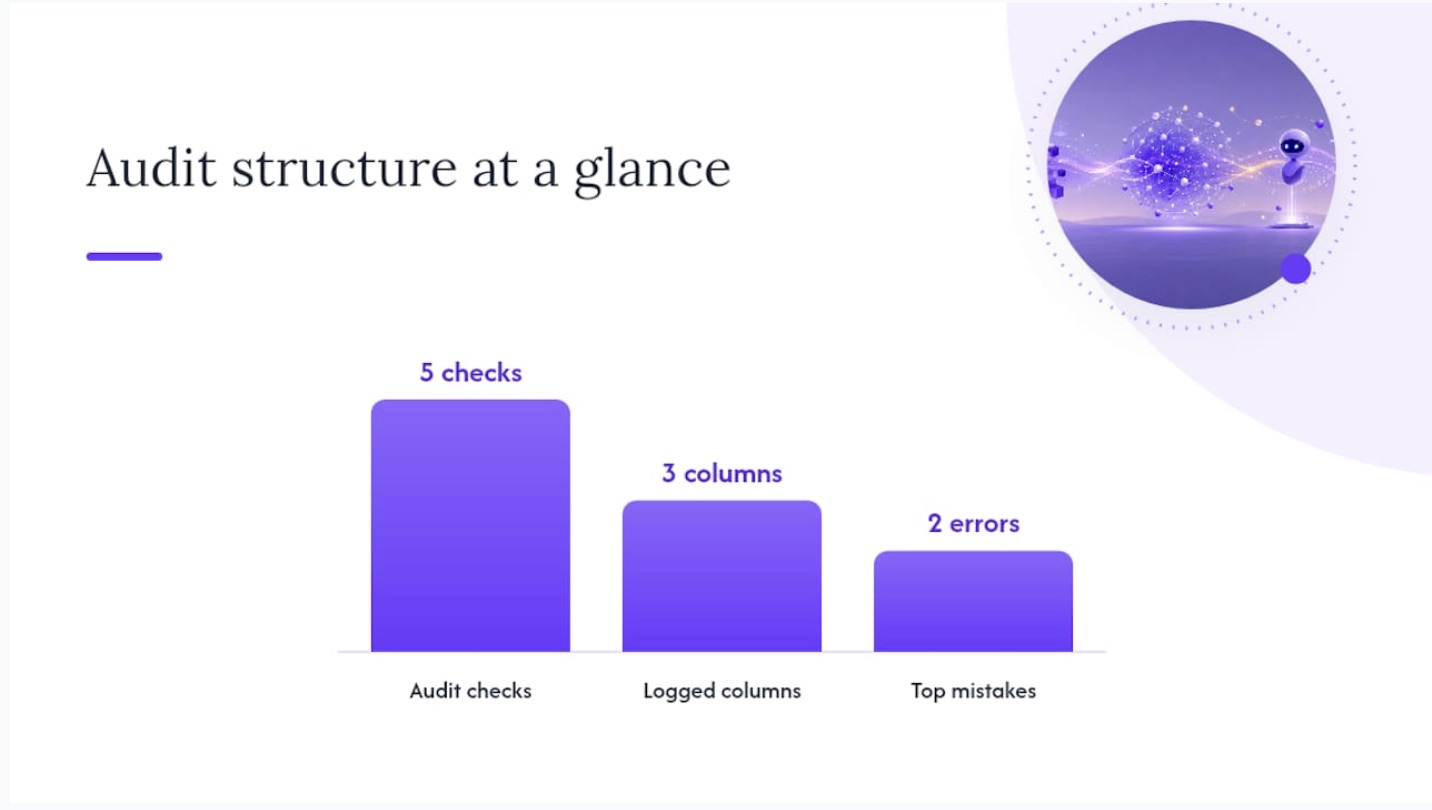
A proper audit separates what's technically broken from what's a sampling illusion. Run through these five checks in order.
- Pull your server logs and isolate bot traffic. Filter for user agents claiming to be OpenAI's GPTBot, Anthropic's crawler, or PerplexityBot.
- Verify against vendor IP prefix files. Every major AI vendor publishes the actual IP ranges their crawlers use. Cross-checking logged requests against those published ranges tells you whether a hit is genuine or a forged request spoofing the user agent string.
- Set up GA4 custom channel groups for AI referrals. Create a channel grouping that catches traffic from chat.openai.com, perplexity.ai, and similar domains, and tag your key pages with consistent UTM parameters so referral clicks from citation links are trackable rather than lumped into "direct."
- Run test prompts in a clean, logged-out session. Open an incognito window with memory and custom instructions turned off. Test ChatGPT Free and Plus as separate conditions, since retrieval behavior and citation frequency differ meaningfully between tiers and engines.
- Log three columns for every run. Crawl verified (yes/no), cited with URL (yes/no), and mentioned by name (yes/no).
Skipping step 2 is the single most common mistake. Teams see "GPTBot" in their access logs, assume they're eligible, and start rewriting content when the real problem is a firewall rule or a CDN blocking the legitimate crawler entirely. Verification takes fifteen minutes and prevents weeks of wasted content work.
Logged-in test sessions are the second-biggest source of bad data. If your custom instructions mention your industry or your account history includes prior searches for your brand, the model's response gets biased toward showing you results it thinks you want, not what a cold, anonymous user would see. Separate accounts, separate browsers, memory off, every time.
Building a Prompt-Sampling Protocol You Can Actually Trust
A single prompt run tells you almost nothing. Non-deterministic outputs mean the same query can return different citations on back to back runs, so the only defensible way to turn that noise into a usable metric is repeated sampling with reported confidence.
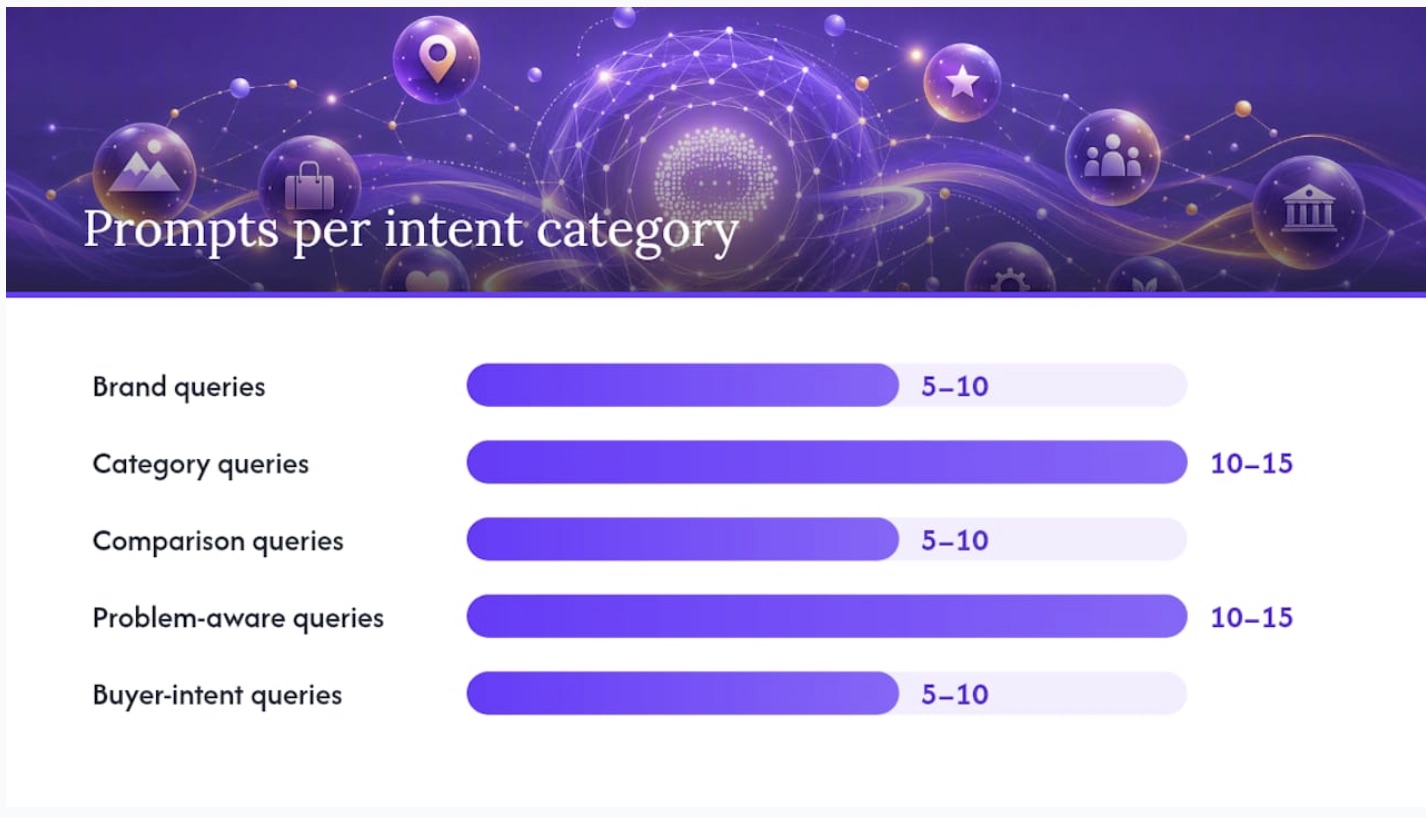
Start with a stratified prompt set covering five intent categories:
- Brand queries ("What is [your company]?") — 5 to 10 prompts
- Category queries ("Best tools for X") — 10 to 15 prompts
- Comparison queries ("X vs Y") — 5 to 10 prompts
- Problem-aware queries ("How do I fix X problem?") — 10 to 15 prompts
- Buyer-intent queries ("Which X should I buy for Y use case?") — 5 to 10 prompts
A protocol like LLMin8's Minimum Defensible Causal framework recommends around 50 intent-stratified prompts with confidence-graded outputs specifically so results are reproducible and comparable across reporting periods, rather than a one-off snapshot you can't defend to a stakeholder later.
Run each prompt at least three times per engine before reporting a mention or citation rate. Three runs won't give you a statistically airtight interval, but it's enough to catch the difference between "this appears reliably" and "this appeared once by chance."
Pro Tip: Weight your cadence to intent priority. Check high-intent buyer prompts weekly, medium-priority category prompts biweekly, and low-priority brand-awareness prompts quarterly. Running everything weekly burns hours you don't need to spend.
Manual sampling works fine at low volume, a few dozen prompts across two or three engines. Once you're tracking hundreds of prompts across ChatGPT, Perplexity, Gemini, and Claude, headless browser automation or a dedicated tracking tool becomes the only way to keep the cadence without burning a full day of analyst time every week.
Which Content and Technical Fixes Actually Move the Needle?
Fix eligibility before you touch content. A perfectly optimized page that a crawler can't reach will never get cited, no matter how well it's written.
Technical priorities:
- Explicitly allow declared AI crawlers (GPTBot, PerplexityBot, ClaudeBot) in robots.txt
- Test with a live fetch tool to confirm the allowance actually works, not just that the rule exists
- Check CDN and WAF rules separately. Many block by IP reputation regardless of what robots.txt says
Allowing declared crawlers in robots.txt is often the single fastest fix for moving a page from ineligible to eligible on engines that rely on live retrieval rather than a static training snapshot.
Content priorities:
- Put a concise, quotable definition statement near the top of key pages, not buried after three paragraphs of throat clearing
- Add FAQ sections with direct question-and-answer pairs the model can extract cleanly
- Keep brand names and product terminology consistent everywhere, on your site and in outside mentions, so the model reinforces one entity rather than fragmenting your identity across variants
Measurement priorities:
- Tag your highest-value pages for ongoing monitoring rather than trying to track everything
- Apply consistent UTM parameters anywhere an engine is known to supply outbound links
What KPIs Actually Show Progress?
Four numbers matter, and none of them mean much without the sample size behind them.
Eligibility rate: the share of verified, legitimate crawler hits against your total expected crawl volume. Citation rate: the share of sampled runs where your URL appeared as a linked source. Mention rate: the share of runs where your brand name appeared in the answer text, cited or not. Sentiment: whether the context around your mention is favorable, neutral, or negative.
Report every rate next to its run count and confidence interval, never as a bare percentage. "34% citation rate" means something different at 15 runs than at 150. Track run-over-run change (delta) alongside the raw number so a stakeholder can see whether last month's content fix actually moved anything or whether the swing is just sampling noise.
- Eligibility rate + verified hit count
- Citation rate + confidence interval + run count
- Mention rate + delta versus prior period
- Sentiment breakdown (positive/neutral/negative)
Where your analytics setup supports it, connect mention and citation deltas to actual AI-referral sessions in GA4, and if you can trace those sessions to conversions, report the revenue influenced rather than just the visibility metric alone. A dashboard reviewed monthly with stakeholders, weekly internally for high-priority prompts, keeps the reporting cadence matched to how fast the underlying data actually moves.
Best Practices for Formatting ChatGPT Citations in Professional Writing
When you reference an AI-generated citation event in a report or case study, precision matters more than style. State the exact prompt used, the date and time of the run, the engine and tier (ChatGPT Free versus Plus, for instance), and whether the session was logged in or clean. A citation claim without those four details is unverifiable to anyone trying to reproduce it.
Format the reference the way you'd format any dated observation: engine name, prompt text (or a representative sample from the set), run date, and outcome (cited, mentioned, or neither). If you're citing an aggregate rate rather than a single run, always attach the run count and confidence interval, not just the headline percentage.
Avoid presenting a single favorable ChatGPT response as proof of "ranking" or "being featured." That single-instance framing misleads readers and stakeholders because non-deterministic outputs mean the same prompt might return a completely different answer an hour later. Professional reporting treats each run as a data point in a sample, not as a standalone result worth screenshotting and circulating.
When documenting methodology for internal or client-facing reports, disclose the prompt library, the number of runs per prompt, the engines tested, and the date range covered. That transparency is what separates a defensible visibility report from an anecdote dressed up as data.
Ethical Considerations When Citing AI-Generated Content
Transparency starts with disclosure. If a report, article, or client deliverable draws conclusions from AI-generated outputs, say so explicitly rather than presenting the model's phrasing as an independent, verified fact.
AI answers reflect probability distributions learned from training data, not verified truth. An engine can state something confidently and incorrectly in the same sentence. Treating a ChatGPT response as a citable authority without independently confirming the underlying fact risks passing along a fabricated detail as though it were sourced and checked.
There's also a fairness dimension specific to brand visibility tracking. Sampling and reporting on how often a competitor appears in AI answers is legitimate competitive research. Publishing that data in a way that implies certainty about a competitor's strategy or performance, when your sample size is small or your runs weren't controlled, crosses into misrepresentation. Report your methodology alongside your findings so readers can judge the strength of the claim themselves.
Finally, be honest internally about what "ghost mentions" mean for your ethics around reporting. If an engine cites your URL in a source list but never actually names your brand in the visible answer, counting that as a full "brand mention" in a stakeholder report overstates your visibility. Distinguish the two outcomes clearly rather than folding them into one flattering number.
Attributing ChatGPT Content vs. Human Authorship
Any brand-facing content that draws on ChatGPT output, whether it's a summary, a draft, or a data point pulled from a chat session, needs a clear line between what the model generated and what a person verified, edited, or added.
The practical rule: if a claim, statistic, or quote in your content originated from an AI session rather than a primary source you checked yourself, don't present it with the same confidence as a fact you verified directly. State plainly that a figure came from an AI-assisted search and was cross-checked, or wasn't.
This matters most in the visibility-tracking work itself. Keep that distinction explicit in internal reports. Conflating "what the AI said" with "what our team measured about what the AI said" muddies accountability when a number gets questioned later.
For any published content, marketing copy, blog posts, or reports, that used ChatGPT as a drafting tool, internal editorial policy should specify what level of human review happened before publication. A draft generated by ChatGPT and lightly edited carries different reliability than one written entirely by a human analyst and merely fact-checked with AI assistance. Readers and stakeholders benefit from knowing which process produced the content in front of them, even in general terms.
How Reliable Is ChatGPT as a Citable Source?
ChatGPT is not a stable, checkable reference in the way a published study or a government dataset is. The same prompt can produce different citations, different phrasing, and even different factual claims across separate runs, sessions, or model versions.
That instability isn't a flaw to route around. It's the reason sampling with run counts and confidence intervals is the only responsible way to treat AI output as a metric at all. A single favorable response proves the model can produce that answer under some conditions. It doesn't prove your brand reliably appears whenever a relevant user asks.
Reliability also varies by query type. Brand-name queries tend to produce more consistent, name-specific answers than broad category queries, where the model is drawing from a wider, more diffuse pool of training signal and live retrieval results. Comparison queries introduce another variable: the model's tendency to default to well-known incumbents regardless of which option is actually best suited to the asker's situation.
Cross-engine variance compounds the reliability problem. Retrieval behavior and citation frequency differ substantially between ChatGPT, Perplexity, Gemini, and Claude, so a strong showing on one engine tells you nothing about your standing on another. Treat every engine as its own measurement environment with its own baseline, not as one unified "AI visibility" score.
How Does ChatGPT Compare to Other AI Engines on Citation Behavior?
Perplexity was built around live retrieval and source citation as a core product feature, so it tends to surface linked source lists more consistently than ChatGPT does for the same query type. ChatGPT's citation behavior depends heavily on whether the session is using browsing or retrieval tools versus responding purely from trained knowledge, which makes its citation rate more variable run to run.
Google's AI Overviews sit closer to traditional search results, pulling from indexed pages with a citation model that mirrors organic search ranking signals more than conversational retrieval. Claude's citation behavior, when browsing tools are enabled, resembles Perplexity's more than ChatGPT's default conversational mode, but adoption and usage patterns differ enough that direct rate comparisons across engines can mislead if reported without engine-specific context.
Compared to a standard citation in academic or journalistic work, where a source is fixed, checkable, and reproducible by any reader, an AI citation is closer to a snapshot of a probabilistic process at one moment in time. That's the core distinction marketing teams need to carry into any report: a ChatGPT citation describes what the model did on a specific run, not a permanent, checkable fact about your brand's standing.
What Marketers Get Wrong About AI Visibility Measurement
The conventional advice treats AI visibility like a vanity metric: screenshot a good ChatGPT answer, drop it in a slide deck, declare victory. That approach falls apart the moment someone reruns the same prompt and gets a different answer, which happens more often than most teams expect.
What the evidence in this piece actually supports is a much less glamorous discipline: verify crawler access before touching content, sample with enough runs to report a real rate, and separate "cited with a URL" from "mentioned by name" every single time. Skip any one of those steps and your reporting is closer to anecdote than measurement.
The biggest blind spot is ghost mentions, engines citing your URL in a source list without ever naming your brand in the visible answer. Most teams checking manually never notice because they only read the answer text, not the citation list underneath it. That gap alone can make a brand look invisible when it's actually being surfaced, just silently.
Prioritize eligibility verification first, sampling discipline second, content polish third. Tools like automated AI visibility checkers exist precisely because doing this by hand, across multiple engines, dozens of prompts, and weekly cadence, is a genuinely unreasonable amount of manual work for any but the largest teams.
— Ned
Prescy: Automated AI Visibility Checks and Next Steps
Everything above — log verification, prompt sampling, separating mentions from citations — is the right workflow. It's also a lot to run by hand every week. Prescy automates the part we can measure reliably today: ChatGPT and Perplexity on your tracked buyer questions, with named-in-X-of-Y counts, cited domains, and a ranked source queue. Google AI Overviews is in testing, not in that loop yet.
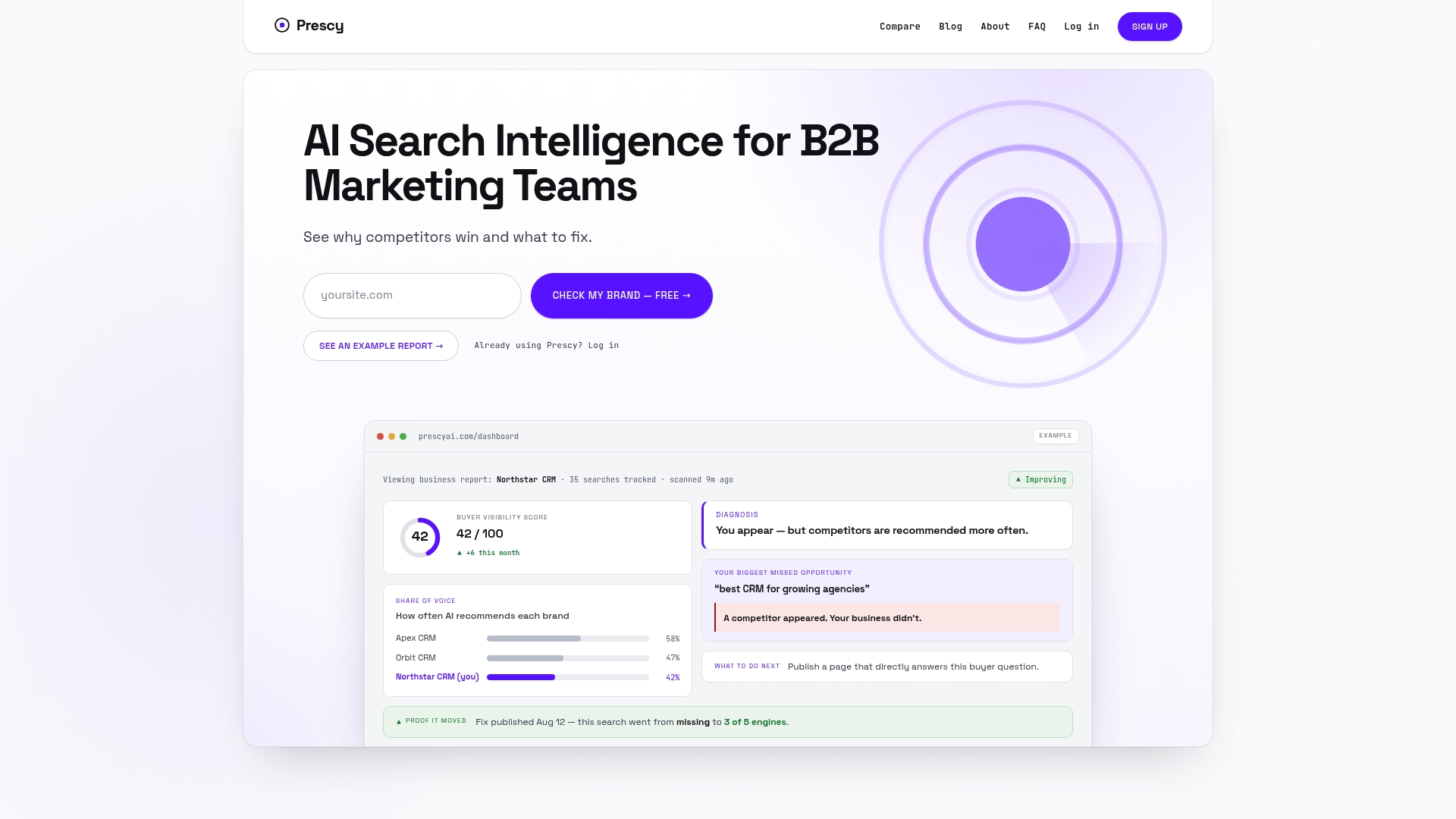
Instead of a monthly manual audit stitched together across spreadsheets, Monitor runs the weekly sampling and reports before-and-after numbers once you act on a source. You see the gap and the fix in one place, with evidence behind both.
Run a free ChatGPT snapshot to see where your brand currently stands, or read the methodology to see exactly how the counts are built.
Sources
- Why Generative AI Responses Lack Citations: Fundamental Limits and Brand Strategy | Hakky Handbook
- How to Track Brand Mentions in AI Search — And Why Your Logs Are Lying - Cyber Kendra
- How to Track Brand Mentions in ChatGPT (Free + Paid Methods, 2026) | Is My Brand in AI
- Minimum Defensible Causal (MDC): A Pre-Registered Framework for Attributing LLM Visibility to Revenue — Implemented in LLMin8 AI Revenue Intelligence