AI overview tracking is the practice of monitoring whether Google shows an AI Overview for a given keyword and whether your site appears among the cited sources. It matters because AI Overviews now sit above the organic results on many searches, and a citation there can offset the click share that Google's summary otherwise absorbs. The immediate payoff is visibility data you can act on: which brands get mentioned, where you rank in the citation order, and how much of your organic traffic dip actually traces back to an AI Overview stealing the click.
TL;DR:
- Tracking AI Overviews reveals whether your brand is cited and how often your content appears above organic results, influencing click share.
- Automated tools provide ongoing data on citation presence, order, and volatility, aiding long-term monitoring and benchmarking.
- Prioritize fixes for keywords with inconsistent citations, first-time competitor citations, or brand mentions without links that impact visibility.
- Consistent content strategies, like answering questions directly and structuring data clearly, improve chances of being cited in AI Overviews.
- Daily verification of citations and content alignment is crucial, especially for high-value keywords, to avoid acting on volatile or inaccurate signals.
What AI Overview Tracking Actually Measures
Most trackers report on a narrow, specific set of signals, and knowing what those signals actually mean saves you from mistaking a vendor dashboard for a magic answer. An AI Overview is a retrieval-augmented summary. Google's model pulls from multiple indexed pages, synthesizes an answer, and attaches citations to the URLs it drew from. A tracker's job is to catch that process in the act, keyword by keyword, and log what it finds.
The core outputs look like this:
- Presence and absence — whether an AI Overview appeared for a tracked keyword, with a timestamp for each check.
- Full text capture — the actual Overview copy, not just a "yes/no" flag, so you can see how your brand or product gets described.
- Citation list and order — which URLs got cited, and in what sequence, since position in the list often correlates with visibility.
- Brand mention detection — whether your brand name shows up in the generated text even without a hyperlinked citation.
- Volatility metrics — how often the Overview itself, or its cited sources, change between checks.
- Indirect measures — estimated click impact and an AI share-of-voice score relative to competitors.
That last category, the indirect measures, is where things get genuinely difficult, because Google doesn't hand you AI Overview impressions the way it hands you organic impressions in Search Console. Trackers have to infer click impact from behavior patterns rather than pull it from a clean report.
One statistic worth sitting with: AI Overviews change roughly 70% of the time between observations, with an average lifespan of about 2.15 days before the content shifts again. A single snapshot tells you almost nothing. A trend line tells you everything.
How AI Overview Tracking Works in Practice
You can approach AI overview tracking at three levels of effort, and most SEO teams end up using a blend of all three depending on how much a keyword is worth.
1. Manual prompt and keyword checks. The simplest method is running searches by hand and screenshotting what comes back. The catch is that prompt phrasing and keyword phrasing don't behave the same way. A keyword like "best running shoes for flat feet" might trigger a different Overview than the conversational prompt "what running shoes should I buy if I have flat feet," even though a human would treat them as the same question. If you're tracking manually, log both forms separately rather than assuming they're interchangeable.
2. Search Console and GA4 workarounds. Google Search Console doesn't expose AI Overview impressions directly, so analysts approximate the impact two ways. First, regex filters isolate queries that are likely to trigger an Overview, things phrased as direct questions or comparisons. Second, you audit for CTR drops on keywords where your average rank hasn't moved, since a ranking that holds steady while clicks fall is a strong hint that an Overview is now sitting above you and absorbing the click. On the GA4 side, some teams configure Google Tag Manager to detect #:~:text= URL fragments, the text-highlighting links Google appends when a user clicks through from an AI Overview citation, and fire a custom event when that fragment shows up in a landing page URL.
3. Automated trackers. Purpose-built tools run daily sweeps across a defined prompt index, archive historical citations, and let you export the evidence for reporting. A reliable tracker records presence, the exact URLs cited, their order, and historical trends so you can benchmark change over weeks instead of guessing from memory. Vendor feature sets in this category commonly include a per-keyword citation checker, prompt set testing against real conversational queries, historical data exports, and competitor benchmarking side by side with your own citations.
Each level trades effort for scale. Manual checks are free but don't hold up past a handful of keywords. GSC and GA4 workarounds are useful triangulation but remain indirect, since Google never confirms an Overview caused the CTR change you're seeing. Automated tools solve the scale problem but need periodic manual spot checks to confirm they're reading citations correctly, especially on keywords where the Overview format is unusual.
Pro tip: Run one keyword through both a keyword-style query and a natural-language prompt every week. If the Overview text and citations differ meaningfully between the two, your prompt set is too narrow, and you're missing half the picture.
How to Prioritize Fixes From Tracking Data
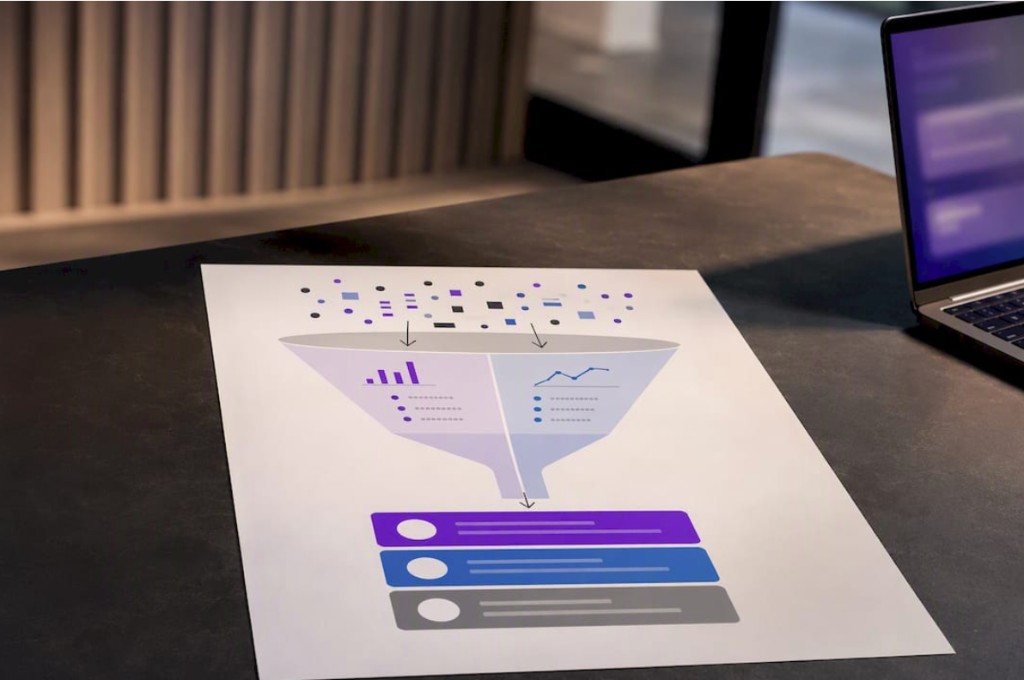
Raw tracker output is not a to-do list. It becomes one only after you run it through a filter that weighs how often you're cited against how much the keyword is worth.
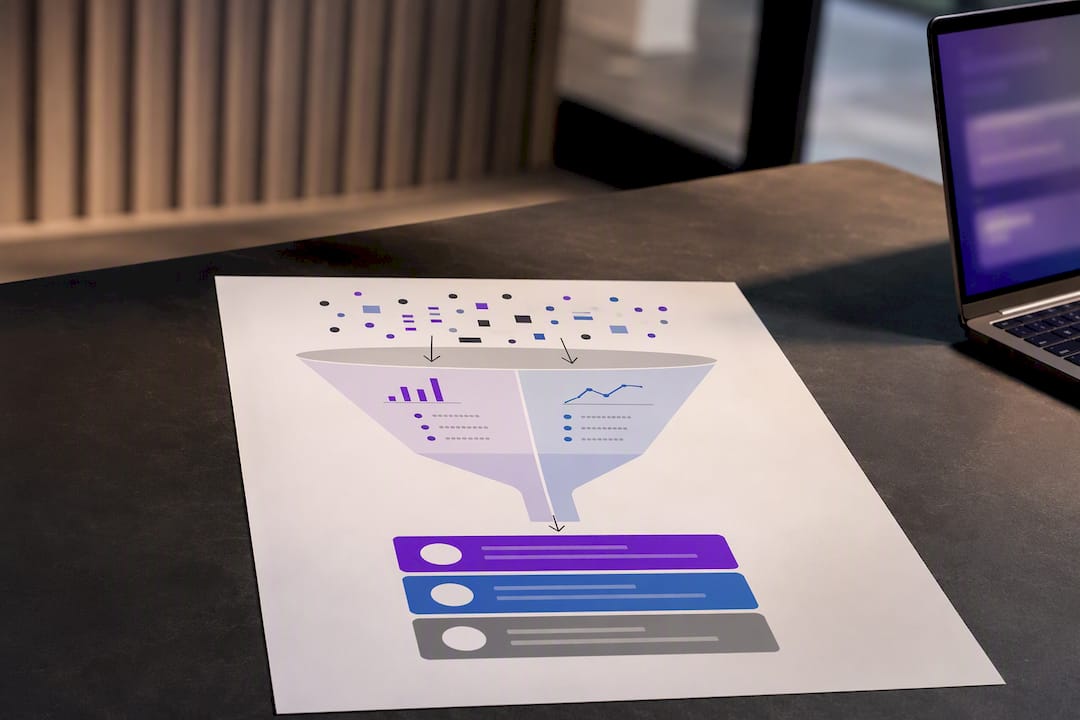
The simplest version of that filter is a two-axis matrix: citation frequency on one side, traffic or revenue potential on the other. A keyword where you're cited consistently and it drives meaningful traffic needs monitoring, not action. A high-value keyword where you're cited inconsistently, or not at all, is your priority list.
Certain signals deserve immediate escalation rather than a routine check next month:
- Repeated citation loss on a keyword you previously held, especially across three or more consecutive checks.
- A CTR drop on a page whose average rank hasn't changed, which usually means an Overview is now absorbing clicks above it.
- A competitor appearing in the citation list for the first time on a keyword tied to a product you sell.
- Your brand mentioned in the Overview text with no accompanying citation link, which suggests you're influencing the answer without capturing the click.
Once a keyword clears the priority bar, the tracker evidence usually points to one of three fix types. A page that's cited inconsistently often just needs a tighter answer at the top, restructured to match how the model is already summarizing competitors. A page that's never cited despite ranking well organically often lacks the structured data or clear heading hierarchy that makes a passage easy to lift. A page that's losing ground to a specific competitor usually needs added evidence, a statistic, a table, a quoted source, that the model can point to as grounding.
Set service-level expectations that match the fix type. Snippet rewrites are quick wins you can measure within one or two tracking cycles. Full rebuilds need a longer runway and should be judged on citation share and named-in-X-of-Y movement over a full quarter, not the following week's snapshot. After the work ships, measure success against three things: whether citation share on that keyword improved, whether your recommendation count moved relative to competitors on the same questions, and whether the organic traffic reconciliation (comparing GSC clicks against your GTM fragment-click data) shows a real recovery rather than a coincidental bump.
Editorial and Technical Tactics That Improve Citation Odds
Getting cited isn't about gaming a black box. It's about making your page the easiest source for a retrieval model to lift cleanly, and that comes down to a handful of concrete habits.
- Lead with a direct answer. Put a two or three sentence summary at the very top of the page that answers the core question in plain language, before any preamble. Retrieval models tend to favor passages that answer cleanly without requiring context from earlier paragraphs.
- Use structured data and clear headings. A page broken into well-labeled sections with schema markup gives the model discrete, snippetable passages instead of one long undifferentiated block of text.
- Add verifiable evidence. Statistics with sources, comparison tables, and direct quotes give a retrieval-augmented model something concrete to ground its summary in, rather than paraphrased opinion.
- Keep brand mentions and metadata consistent. Inconsistent naming across your site, your listings, and your social profiles makes it harder for a model to associate a citation with your brand confidently.
- Earn third-party coverage. Reviews, roundups, and "best of" lists that mention your brand supply external evidence the model can cross-reference, and this matters more than most teams assume. Because AI Overviews synthesize across multiple sources, being cited often depends as much on what other sites say about you as on your own page's optimization.
Pro tip: If a competitor keeps showing up in the citation list ahead of you on a keyword you rank higher for organically, check their page's opening paragraph first. Nine times out of ten, they're answering the question in the first sentence and you're not.
None of these tactics guarantee a citation on any single check, given how much Overviews shift day to day. But applied consistently across a content set, they raise your odds meaningfully, and that's the only kind of improvement worth chasing here.
Verifying Signals Before You Act on Them
The volatility that makes daily tracking necessary is the same volatility that can trick you into reacting to noise. Before you greenlight a content fix based on tracker data, run a quick sanity check.
Start with the baseline number: a roughly 70% chance an Overview changes between two observations, with sources persisting an average of just over two days. That means a single missed citation on Tuesday might simply be back by Thursday with no work required. Daily monitoring exists precisely because one-off checks miss this churn and lead teams to chase a problem that resolves itself.
The bigger risk is acting on a hallucinated citation, an Overview that references your URL but misrepresents what the page actually says. The fix is a simple grounding check: pull the specific passage the Overview attributes to your page and confirm it actually appears there in that form. If it doesn't match, the citation is unreliable and no amount of content optimization will stabilize it, since the mismatch sits on Google's side, not yours.
Match your monitoring cadence to keyword value rather than tracking everything at the same frequency:
- Daily checks for your highest-value commercial keywords, where a lost citation has real revenue weight.
- Weekly checks for mid-tier and informational keywords that support the funnel but don't convert directly.
- Biweekly or monthly checks for long-tail keywords where volume is too low to justify daily attention.
Before escalating any single data point, run it through a short checklist: has this pattern repeated across at least three checks, does the cited passage actually match your page content, and has the keyword's overall search volume stayed stable during the observation window? If all three hold, you're looking at a real signal, not a blip.
How Prescy Complements Overview Tracking Today
Manual checks and Search Console workarounds get you partway there for Google AI Overviews. Prescy was built for the adjacent problem: buyer questions on ChatGPT and Perplexity, where you need named-in-X-of-Y counts, cited domains, and a next action — not a proprietary score.
Google AI Overviews is in testing inside Prescy and not in the live weekly loop yet. Until that ships, use Search Console’s Generative AI performance report for Overview impressions, and use Prescy for ChatGPT and Perplexity on the same commercial journeys.
Where Prescy earns its place in a marketer's stack today:
- It diagnoses the gap between your brand and competitors on the exact buyer searches you're tracking in ChatGPT and Perplexity.
- It converts that gap into a ranked source queue — specific URLs and what to do on each — rather than a raw citation dump.
- It rechecks after you implement a fix, so you can see whether a rewrite actually moved the count.
- It gives agencies and in-house teams a shared reporting layer with the methodology behind every fraction.
Start with a free ChatGPT snapshot to see where your brand currently stands on buyer questions, keep Search Console as your Overview track, and treat a 30 to 60 day window as the minimum for judging whether editorial fixes moved anything.
Comparing the AI Overview Tracking Tool Landscape
Tools in this category tend to split into three tiers, and picking the right one depends on how much of your workflow you want automated versus how much you're willing to build yourself.
At the entry level, free checkers let you paste a keyword and see a snapshot of the current Overview and its citations. These are useful for spot checks and for validating a vendor's claims before you commit to a subscription, but they don't retain history, so you lose the trend line that matters most given how often Overviews change.
Mid-tier tools add scheduled checks, historical archives, and basic competitor comparison. This is where most SEO teams land, since the cost is proportional to the number of keywords tracked and the reporting is built for recurring stakeholder updates rather than one-time audits.
At the top end sit platforms that combine multi-engine coverage (checking ChatGPT and Perplexity alongside Google AI Overviews) with diagnostic recommendations, not just detection. The distinction that matters most when comparing options isn't the price tag. It's whether the tool tells you what's cited, or whether it also tells you why you're not cited and what to fix. A broader look at AI visibility platforms and their tradeoffs is worth reviewing before you commit budget to any single tool.
Setting Up Alerts and Reports That People Actually Read
An alert system that fires on every citation change trains your team to ignore it within a week. The goal is signal, not noise, so build thresholds around what actually warrants a response.
Configure alerts to fire only when a citation loss repeats across two or more consecutive checks on a keyword above a defined traffic or revenue threshold, not on the first miss. Route high-value keyword alerts to a Slack channel or email distribution that a specific person owns, so accountability doesn't get lost in a shared inbox nobody checks.
For recurring reports, weekly is usually the right cadence for stakeholder updates, since it smooths out day-to-day volatility while still catching real trend shifts. Structure the report around three sections: citation share over time, keywords with the largest week-over-week movement, and a short list of recommended actions tied to specific pages. Skip the temptation to report every keyword tracked. A report with 200 rows gets skimmed once and ignored forever; a report with the ten keywords that moved the most gets read every time.
What AI Overviews Are Doing to SEO Strategy
The shift here isn't cosmetic. Traditional SEO optimized for rank position on a results page that stayed relatively stable once you earned a spot. AI Overviews compete for attention above that page entirely, and they reshuffle their sources far more often than organic rankings ever did.
That changes what "winning" a keyword means. Ranking first organically no longer guarantees the click if an Overview above you cites a competitor instead. Teams that treat AI Overview citations as a separate, trackable metric, rather than an assumed byproduct of good rankings, are the ones catching the traffic loss early enough to respond. It also changes content planning: pages now need to serve two audiences at once, a human reader scanning for depth and a retrieval model looking for a clean, quotable passage near the top. Content teams that split the difference, front-loading a direct answer while still building out the depth that keeps human readers engaged, tend to perform better in both contexts than pages optimized for just one.
Real-World Patterns in Effective AI Overview Response
A few recurring patterns show up across teams that manage this well, even without naming specific brands or campaigns.
The most common pattern is the "snippet rescue." A page ranks well organically, loses citation share to a competitor, and the fix is almost always structural rather than a full rewrite: moving the direct answer higher, tightening it to two or three sentences, and removing the throat-clearing paragraph that used to sit above it. Teams that make this change consistently see citation share recover within a few tracking cycles, though the exact timeline depends on how often the keyword's Overview refreshes.
A second pattern involves third-party evidence. Brands that were mentioned in the Overview text but never cited with a link often trace the problem to a lack of external validation, no reviews, no roundup mentions, nothing for the model to cross-reference beyond the brand's own site. Closing that gap tends to involve outreach for coverage rather than on-page changes.
A third pattern is the false alarm. The lesson holds across almost every case: verify before you rebuild, and let the trend line, not the single snapshot, decide what gets prioritized.
The Operational Workflow That Actually Works
Treat AI overview tracking as a five-step loop: detect a citation change, verify it's grounded in real content rather than a hallucination, prioritize it against your traffic-value matrix, ship the specific fix the evidence points to, and measure whether citation share actually moved. Skip verification and you'll burn sprint capacity chasing volatility that resolves on its own within a couple of days. Skip prioritization and you'll spend a content team's month on a long-tail keyword that never moved revenue in the first place.
The teams that get the most out of this discipline are the ones who treat it like a reporting cadence, not a one-time audit. A broader view of how AI visibility fits into overall search marketing measurement is worth working into your regular reporting rhythm alongside standard organic KPIs. The workflow only pays off when it runs continuously, because the thing you're tracking never sits still.
— Ned
Get Prescy Measuring Your Buyer Questions
Building Overview tracking by hand — spreadsheet checks, GTM fragment tracking, manual prompt testing — eats hours every week. Prescy closes the ChatGPT and Perplexity half of that gap today: weekly repeated samples on your tracked buyer questions, cited domains, and a ranked source queue. Google AI Overviews stays on Search Console until Prescy’s AIO loop leaves testing.
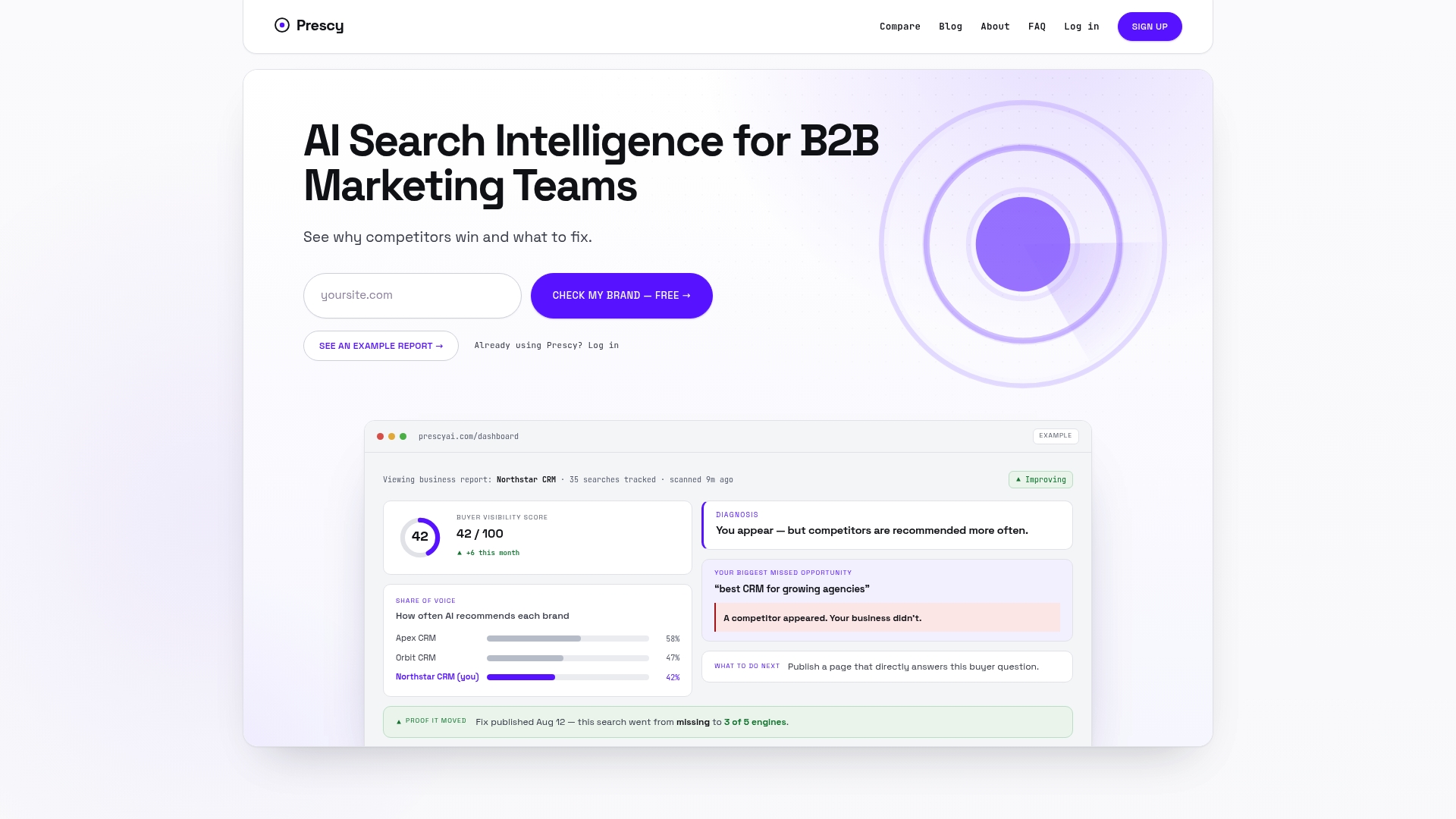
What makes it worth adding to your stack is the diagnosis layer. Most trackers stop at "here's who got cited." Prescy shows the specific gap on the buyer searches that matter, with a transparent count (named in X of Y), and then quantifies whether your fix actually worked once it ships.
If you're currently guessing at AI visibility from Search Console workarounds alone, run a free ChatGPT snapshot this week, keep Overview impressions in Search Console, and give Monitor a few weekly rechecks to show real movement on the questions that matter.