AI search analytics is the practice of tracking how often AI engines cite, mention, or attribute answers to your brand, then connecting those citations to conversions. The one move that separates teams making progress from teams guessing: build a baseline prompt set of real buyer questions, run it across engines, and log which pages get cited and which visits turn into leads.
TL;DR:
- Tracking AI citations and mentions requires monitoring across multiple engines, with a focus on content clarity and answerability rather than keyword density.
- Server logs provide the most cost-effective signals by showing which pages bots crawled, with citation and answer-level testing offering additional validation.
- Business impact metrics such as AI-driven click-throughs and conversion rates are more meaningful than visibility alone in measuring AI search success.
- Implementing a structured 90-day process involving baseline prompt building, prompt validation, content adjustments, and tracking delta is essential for progress.
- Using tools that cover multiple engines, offer citation details, and integrate with existing analytics ensures comprehensive, actionable AI search analytics.
Table of contents
- What is AI search analytics, and how does it differ from SEO analytics?
- The three measurement layers every team must track
- Which metrics matter: visibility, citations, and business impact
- Tool checklist: what to look for in an AI search analytics solution
- Implementing an AI search analytics workflow (step-by-step)
- Cross-engine testing and the query fan-out: advanced tactics
- What successful teams do differently
- How Prescy helps: AI visibility tracking and next steps
- Sources
What is AI search analytics, and how does it differ from SEO analytics?
AI search analytics measures citations, brand mentions, and the answer snippets AI engines pull from your content when someone asks a question in ChatGPT, Perplexity, Gemini, or Google AI Overviews. Traditional SEO analytics measures rankings and click-through rates on a results page with ten blue links. Those two things behave nothing alike.
Classic SEO rewards exact-match keywords and backlink authority tied to a specific URL holding a specific position. AI engines don't rank pages, they synthesize answers, often blending three or four sources into one response with no fixed position to track. That means entity clarity, whether your brand, product, and claims are unambiguous to a language model, matters more than keyword density ever did.
AEO shifts the target from keyword volume to intent, entities, and answerability, and pages that cover three to four levels of follow-up questions perform best in citation testing. If your content answers the question clearly and anticipates what a buyer would ask next, you have a real shot at being the source an AI engine quotes.

The three measurement layers every team must track
AI visibility work happens across three distinct data layers, and most teams only look at one.
- Layer 1: Server-side crawls and logs. Your server logs show exactly which pages LLM bots like GPTBot and PerplexityBot actually crawled, which is different from what Google indexes.
- Layer 2: Platform citation reports. These aggregate citation data and raw source URLs so you can see which domains an engine leans on for a given topic.
- Layer 3: Answer-level intelligence. This means testing prompts directly in ChatGPT, Perplexity, and similar tools to see whether your content gets synthesized into the actual answer.
Server-side crawl and log data is one of the highest-ROI signals available because it shows what bots accessed, not what you hope they accessed. Teams with limited resources should start there, since it requires no new tooling beyond log access. Teams with more bandwidth should layer in citation reports and answer-level testing to validate what the logs suggest.
Which metrics matter: visibility, citations, and business impact
Two categories matter here, and conflating them is the most common reporting mistake. Primary visibility metrics include AI citation count, mention frequency, visibility share against competitors, and the number of pages actually crawled for citation purposes.
Business metrics matter more, because AEO performance should tie back to conversion rate and revenue, not visibility alone. Track click-throughs originating from AI-generated answers, assisted conversions where an AI citation appears somewhere in the buyer journey, and conversion rate uplift on pages after you improve their answerability.
You can capture most of this with tools you already run:
- Google Search Console for referral patterns and query-level visibility
- GA4 for assisted conversion paths and landing page performance
- Server logs for bot crawl frequency
- An AI-visible tracker for cross-engine citation counts
Tool checklist: what to look for in an AI search analytics solution
Before you commit budget to a platform, run it against this checklist during a demo.
- Cross-engine coverage. Confirm it tracks ChatGPT, Perplexity, Gemini, and Google AI Overviews, not just one, and ask how often that data refreshes.
- Citation detail. It should surface actual domains and URLs cited, not a vague “visibility score” with no source trail.
- Prompt-set testing. Look for reproducible baseline prompts you can rerun monthly to track change over time.
- Team functionality. Multi-client reporting, alerts for citation drops, and clean exports matter if you're managing more than one brand.
- Integrations. Confirm it connects with GSC, GA4, or server logs, since isolated citation data without conversion context is only half the picture.
No single AEO-native tool handles discovery, validation, and tracking at scale, so expect to pair a dedicated visibility tracker with your existing analytics stack rather than replacing it outright.
Pro tip: Ask any vendor for a sample export before you buy. If the export is a screenshot instead of structured data, you won't be able to build a real reporting cadence around it.
Implementing an AI search analytics workflow (step-by-step)
A 90-day rollout keeps this manageable instead of overwhelming your team with data from day one.
- Build a baseline prompt set. Pick 10 to 30 real buyer questions and map the follow-up questions each one triggers.
- Validate which prompts get synthesized. Run each prompt across engines and record which ones generate a full AI answer versus a plain list of links.
- Instrument your measurement. Pull GSC exports for question-format queries sitting in positions 2 to 15, cross-reference server logs, and connect a citation tracker.
- Prioritize by conversion potential. Rank pages by which ones already convert, then fix the ones missing clear entity coverage first.
- Run controlled content experiments. Update one variable at a time (structure, specificity, entity clarity) and retest the same prompts.
- Measure the delta. Compare citation counts and conversion rates before and after, then repeat the cycle monthly.
Cross-engine testing and the query fan-out: advanced tactics
Query fan-out is the reason single-prompt testing fails. When someone asks an AI engine a question, the model often generates internal follow-ups before landing on a final answer, and content that maps three to four levels of that chain has a meaningfully better shot at being cited as a source.
- Test your seed prompt and its likely follow-ups across ChatGPT, Perplexity, Gemini, and Google AI Overviews, then log where citations overlap and where they diverge.
- Pair GSC exports with a tool like AlsoAsked to map the follow-up questions buyers actually ask, then confirm those targets with direct testing.
- Track a prompt tracker alongside your citation data to catch when a previously cited page drops out of rotation.
Pro tip: Overlap across engines is the strongest signal you have. A page cited by two or three engines for the same query is worth defending; a page cited by only one is worth a second look before you invest more content around it.
What successful teams do differently
The teams that make real progress assign one owner to monitoring cadence, not a committee that checks in quarterly. Their fastest wins come from fixing high-conversion pages that are simply missing clear entity coverage, not from chasing raw citation volume. The mistake I see most often: obsessing over ChatGPT while ignoring Perplexity and Google AI Overviews, which quietly cite different sources for the same question.
— Ned
How Prescy helps: AI visibility tracking and next steps
Manually running the same buyer questions every week is not sustainable for most marketing teams, and that gap is what Prescy is built for. Today Prescy watches ChatGPT and Perplexity — for ChatGPT, the logged-out web version, the same thing your buyer sees. The free snapshot asks eight questions once. Monitor asks 60 core questions every week — up to five times on ChatGPT and five on Perplexity — shows which domains were cited, and ranks where to act. Google AI Overviews is in testing, not in this loop yet.
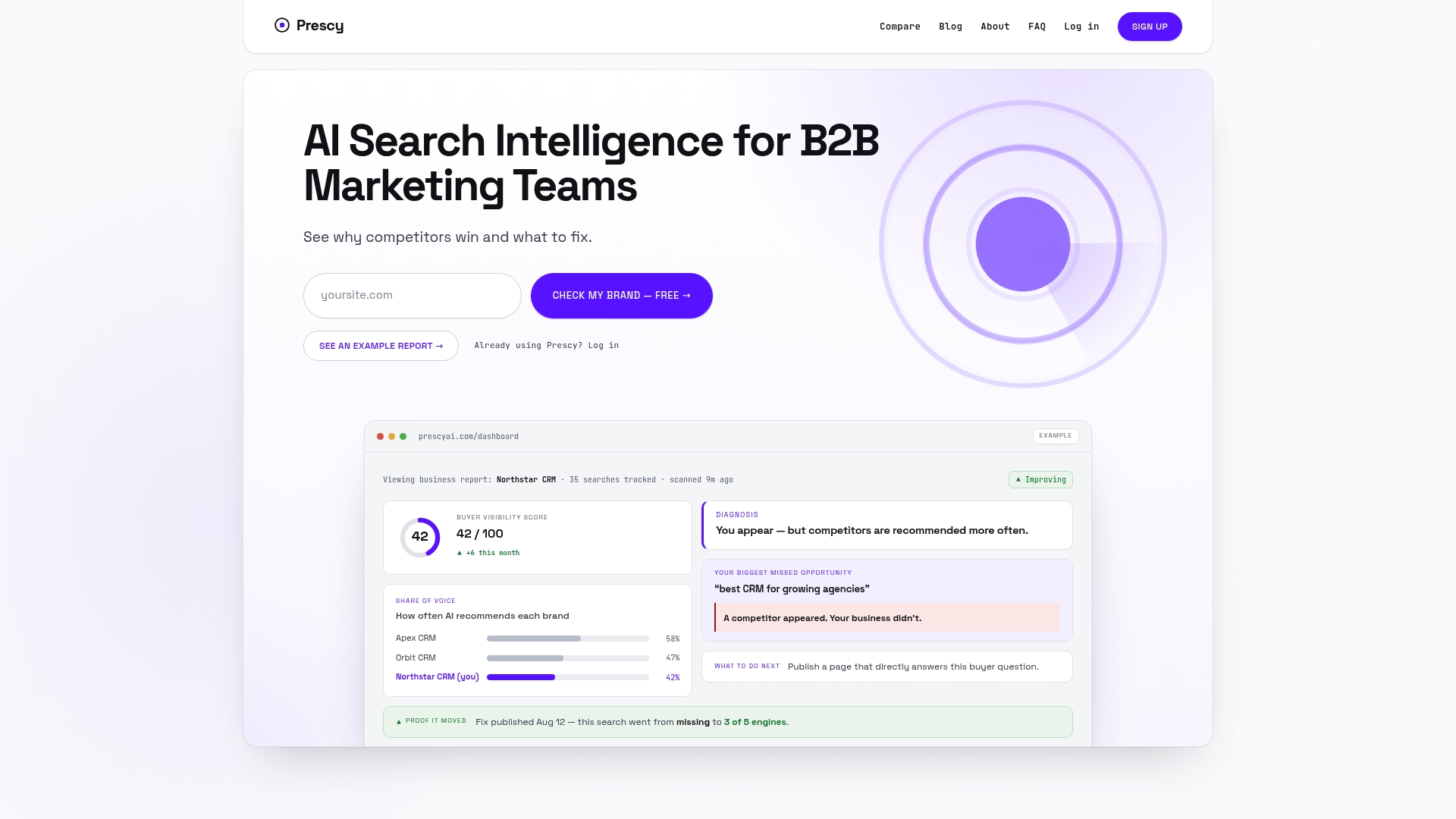
Where most trackers stop at a score, Prescy keeps the original ChatGPT answers, so you can see who was named and which page was cited. It does not connect to your CRM or analytics, so it cannot count people who arrived from AI. If you want to see where your brand currently stands, run a free ChatGPT snapshot or read how we measure before you pay.
Sources
For deeper reading on the mechanics covered here, HubSpot's AEO keyword research guide breaks down query fan-out in more detail, Oncrawl's AI Search Lens documentation covers crawl and citation tracking, and Everyday on AI's practical GSC-to-AEO walkthrough is worth bookmarking for prompt-set building.
- Keyword research for AEO: A guide for winning answer engine traffic in 2026
- AEO Keyword Research: Finding Answer-Intent Queries (2026 Guide) — Everyday on AI